Appendix A: Analysis and Assessment of Individual Measures
1.1 Regulatory Framework for Industrial Greenhouse Gas Emissions
Table 4: Summary of Analysis for Regulatory Framework for Industrial Greenhouse Gas Emissions
| Program | Projected Emissions Reductions in Mt |
Key Determinants of Results | Predictive Accuracy | ||||
|---|---|---|---|---|---|---|---|
| 2008 | 2009 | 2010 | 2011 | 2012 | |||
| Regulatory Framework for GHG Emissions | 0 | 0.9 | 46.6 | 55.3 | 61.6 |
|
Likely overestimate of actual reductions |
Summary of the Initiative and Emissions Projections
The Regulatory Framework for Air Emissions (Canada, 2007b) imposes emissions reductions on Large Final Emitters (LFE) forcing affected firms to achieve an 18% reduction in GHG intensity from 2006 levels beginning in 2010, with a further 2% improvement required in each year thereafter. Affected firms may comply with the regulations either through internal abatement, through contributions to a climate change Technology Fund (at an initial rate of $15/tonne), by purchasing the right to claim emissions reductions made by other domestic firms through the emissions trading and offset systems, or by purchasing emissions reductions credits through the CDM mechanism defined under Kyoto. Firms may also claim a one-time credit for GHG reductions between 1992 and 2006.[28] Emissions reductions attributed to the Regulatory Framework for Air Emissions total 164.4 Mt over the five-year Kyoto compliance period.
Analysis
Since the NRTEE 2008 Response, and even since the release of the government's 2009 Plan, significant information has been forthcoming on the result of the 2007 Regulatory Framework with respect to its role in Canada's climate policy. Recent speeches and statements from Environment Canada have suggested implementation of the Regulatory Framework will not commence before 2011 and stating that Canada will be aligning its climate policies with those of the U.S. in order to facilitate the implementation of a North American cap-and-trade regime and other [29] policy approaches. The preamble to the 2009 Plan states that, "to comply with the Act, this Plan includes the expected emissions reductions for the industrial regulations as described in Turning the Corner, though the final regulatory regime will differ from Turning the Corner". Since this statement implies that these regulations will change, it follows that the emissions reductions attributable to them are likely to change also, and will not occur as stated. Whether the new policy will result in fewer or greater emissions than would have been inventoried under the Regulatory Framework cannot be assessed at this time. In order to fulfill the NRTEE's mandate, an assessment of the reported estimates is provided below under the assumption that the policy is implemented as outlined in Turning the Corner.
The estimates provided in the Plan are computed using Environment Canada's integrated Energy, Emissions and Economy Model for Canada (E3MC) that tests the policy against a Reference case and thereby generates an estimate of the incremental impact of the regulatory measures. Two key issues led to a conclusion that the emissions reductions attributed to this program are likely overestimates and both are tied to the suite of compliance options available to firms. Both issues are explored in detail below. First, the estimates continue to report reductions in Regulatory Emissions rather than reductions in the actual emissions that will be reported in greenhouse gas inventories. Second, in modelling of offsets, the assumptions are such that the cost of offsets is likely overstated, which has ambiguous consequences in terms of emissions reductions during the Kyoto time frame.
In its 2007 and 2008 responses, the NRTEE highlighted a lack of clarity with respect to the treatment of Technology Fund contributions and credits for early action. Technology Fund contributions and credits for early action are likely to account for a large percentage of firms' predicted actions to comply with regulations under the Framework for Air Emissions. Given that the Technology Fund compliance fee of $15 per tonne is likely to be among the less expensive compliance options available to firms, it follows that the full 70% of compliance requirements that are allowed to be offset through the Technology Fund will likely be undertaken (70% in 2010, 65% in 2011, 60% in 2012). While it is impossible to say with certainty what option firms will choose, previous Environment Canada modelling has predicted that the Technology Fund will be used to the full extent possible. Figure 7 below shows Environment Canada predictions of the compliance price in each year from 2010 onward, and it is always greater than the $15 rate at which compliance credits may be purchased through contributions to the Technology Fund. If this is the case, unless firms prefer more expensive compliance to the regulations, the Technology Fund contributions can be expected to be maximized.
Figure 7: The Marginal Cost of Compliance for Firms Under the Regulatory Framework [30]
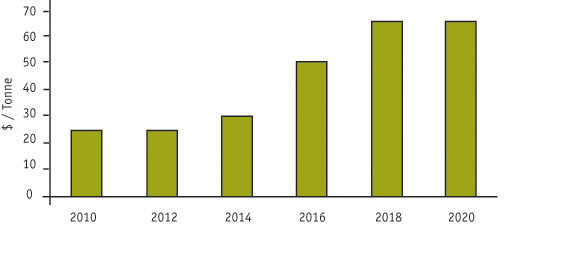
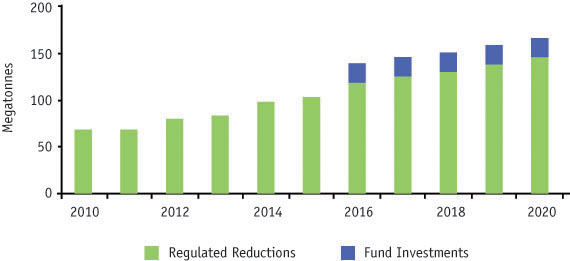
If firms are principally complying through the use of the Technology Fund, actual emissions will not decrease by as much as predicted in the Plan. By definition, payments into the Technology Fund are made to offset emissions that have occurred, and that would be counted by an emissions inventory. Contributions to the Technology Fund will be used to finance future emissions reductions; however, in this case, there is no guarantee that the quantity of future emissions reductions will be equivalent to the volume of emissions offset by contributions made today, and accounting for them in this way will lead to inaccurate predictions of future actual emissions inventories. In these inventory reports, previous actions or contributions to technology funds will not count against actual emissions. Previous analysis from Environment Canada, as shown in Figure 8, illustrates how regulatory emission reductions from the Technology Fund are included both in 2008-2012 and as reductions from Fund Investments in 2016-2020.
The regulation also allows credits of up to 15 Mt for early action, defined as activities that reduced emissions between 1990 and 2006. While these activities may have resulted in emissions reductions in the past, they do not represent incremental reductions in emissions during the Kyoto compliance period, and will not be taken account of in the emissions inventory.[31] If any credits for early action are granted the impact of the policy on actual emissions will be less than that reported in the Plan. Approximately 40 Mt of actual emissions per year from 2010-2012 will be offset in regulatory terms through use of the Fund and through credits for early action.[32] This accounts for between 70 and 80% of all compliance activities under the large final emitters program. These emissions will appear in Canada's emissions inventories for the Kyoto period, since this measure tabulates actual emissions and will not take account of regulatory credits or the Technology Fund.
Figure 8: Environment Canada's Estimate of Industrial GHG Reductions under the Regulatory Framework [33]
Offsets present another source of likely overestimation of reductions. Offsets are essentially the outsourcing of environmental compliance. Rather than reducing emissions in their own facility, a firm may choose to pay another firm to reduce emissions in their operations if the selling firm can do so more cheaply. Since, as far as either climate change or Canada's emissions inventories are concerned, emissions from either source have the same impact, as long as the reduction actually occurs, there is not an issue with offsets.
However, offsets are subject to concerns of additionality. When the government grants an offset credit, it must assess whether emissions reductions are "real, incremental, quantifiable, verifiable and unique reductions of greenhouse gases."[34] The key question is relative to which baseline the offsets are judged to be incremental. In order for offsets to generate emissions reductions, the actions undertaken must be incremental to what would have happened absent the offset program, and this is impossible to know. In practice, the offset rules stipulate that an offset will be granted for activities such as "a reduction in the amount of tillage on farmland...or...generation of electricity from wind energy."[35] As the NRTEE has pointed out with respect to many of the program-level evaluations, it is difficult or impossible to ensure that all offsets are granted for incremental emissions reductions. Attaching an exact number to the additionality concerns with offsets is difficult. Authors such as Jaccard and Rivers (2008) have argued that up to 80% of offsets generated under the federal government’s guidelines would not represent incremental reductions in emissions.
In modelling the effects of the Regulatory Framework, Environment Canada assumed that only offsets from landfill gas and agricultural methane capture would be available to firms. In reality, the scope for potential offsets goes far beyond these two sectors. The new information released on the offset plan suggests "potential projects that could qualify for offset credits include methane capture and destruction from landfill gas, afforestation and other forestry projects, agricultural soil management and wind energy."[36] If the offset potential in each of these sectors were added to the model, a much larger number of emissions offsets would likely be available at any given price. In other words, at $10/tonne, suppose 1Mt of offsets would be supplied from landfill and agricultural gas capture, Environment Canada modelling treats this as the total supply in the market. However, if other sectors can also participate, the supply would be greater at $10 per tonne. In this case, firms would likely use more offsets and fewer other means of compliance to meet their obligations under the Regulatory Framework than would be predicted by Environment Canada's modelling.
There is a link between the issues of offsets and the Technology Fund. Under the regulatory framework, firms are likely to be deciding at least in part between the use of offsets and the use of the Technology Fund to meet the majority of their compliance requirements. As the Technology Fund contributions will not be reinvested to generate any emissions reductions until after 2012, these payments have no effect on actual emissions during the Kyoto time frame as discussed above.
While it is outside the scope of the KPIA, it is important to note that we do not know how many incremental emissions reductions will eventually be generated for each dollar contributed to the Technology Fund, and so we cannot say whether emissions will be under- or overestimated in the long run given the modelling assumptions on the supply of offsets. What we can say is that it is unlikely that offsets will each represent an incremental emissions reduction in the KPIA period and, due to the limited sectors assumed in the modelling, it is likely that more offset transactions will occur than those currently modelled by Environment Canada.
Finally, it is important to recognize that the emissions reduction requirements under the Regulatory Framework are not absolute with this policy, but rather the actual reductions will depend on the level of economic activity since the policy requires reductions in emissions per unit of output. The reductions reported in the Plan as a result of the Regulatory Framework are reductions relative to business as usual. If economic growth is faster than expected, business as usual emissions would be higher and the compliance requirements imposed by the emissions intensity standard would be higher also. If, on the contrary, growth is slower, the requirements lead to fewer emissions reductions (but the business as usual emissions are also lower). Evaluating reductions relative to business as usual under an emissions-intensity standard is more difficult than it would be with an absolute requirement since the compliance requirements change with the underlying economic growth trajectory as well as with technological progress.
Conclusions
The above analysis suggests that significant emissions reductions and contributions to future emissions reductions will result from the Regulatory Framework for Air Emissions. However, since the estimates provided continue to equate the use of any of the compliance mechanisms with emissions reductions, they are likely an overestimate of actual reductions within the KPIA period. Further, as indicated by the Government, the Regulatory Framework will be modified in its content and timeline, so final determination of accuracy of emissions reductions forecasts must wait.
<< Previous page | TOC | Next page >>
____________________________
28 With respect to the particular mandate of this study, the provision for early-action means that firms can receive credit for emissions reductions already undertaken prior to 2006. It is important to note here that, while these reductions would be credited under the Regulatory Framework against 2010 —2012 emissions, they hold no standing with regard to the Kyoto Protocol.
30 Canada, 2008b. http://www.ec.gc.ca/doc/virage-corner/2008-03/571/p2_eng.htm
31 There are no credits for early action in the emissions inventory — only a tabulation of actual emissions. Previous actions, as long as they still have an effect on today's emissions will mean that emissions are lower today than they otherwise would have been, but that is irrelevant. If firms are granted credit under the Regulatory Framework for Air Emissions (RFAE) for actions in the past, these will be used to offset emissions that actually occur during the Kyoto period for compliance with RFAE, but these emissions will still appear in Canada's Emissions Inventory.
32 The 2008 Response cited a figure of 20 Mt, which only included contributions to the Technology Fund to offset compliance requirements under the emissions-intensity targets within the RFAE. However, based on new analysis of information acquired from Environment Canada, the 2008 total compliance figures, if emissions intensity compliance and compliance with flaring and HFC guidelines, were both included, 40 Mt of Technology Fund contributions would be made in total. The 2009 figures are consistent with this adjustment.
33 Canada 2008. http://www.ec.gc.ca/doc/virage-corner/2008-03/571/p2_eng.htm#2_1
34 See http://www.ec.gc.ca/default.asp?lang=En&n=714D9AAE-1&news=C890F013-F3EB-4BCA-A5D9-3B6C2427DA55