Appendix A: Analysis and Assessment of Individual Measures
1.3 Regulating Renewable Fuels Content
Table 6: Summary of Analysis for Regulating Renewable Fuels Content
| Program | Projected Emissions Reductions in Mt |
Key Determinants of Results | Predictive Accuracy | ||||
|---|---|---|---|---|---|---|---|
| 2008 | 2009 | 2010 | 2011 | 2012 | |||
| Regulating Renewable Fuels Content | 0 | 0 | 0.3 | 1 | 2.1 |
|
Undetermined |
Summary of the Initiative and Emissions Projections
Regulations will require 5% renewable fuel content by volume for gasoline from 2010 and 2% by volume for diesel fuel and heating oil by no later than 2012. The estimates provided in the 2009 Plan are slightly higher for 2010, 2011, and 2012 relative to those reported in 2008.
Analysis
The projections in the 2009 Plan are derived by estimating incremental volumes of biodiesel and ethanol produced, and calculating emission reductions using conversion factors that specify the amount by which total GHG emissions are reduced when gasoline and diesel are produced from biomass rather than from petroleum. The 2008 Plan improved on the 2007 Plan to reflect only incremental volumes produced as a result of the regulation, and this improvement is again included in the 2009 Plan.
Three key sources of uncertainty surround the impact of this regulation. First, how the ethanol and biodiesel is produced will have a substantial impact on the emissions reductions. Second, where the ethanol and biodiesel is produced could have an impact. Finally, and perhaps most importantly, what effect the increase in ethanol and biodiesel has on domestic production of gasoline and diesel will determine the induced reductions. Each of these is discussed in turn below.
The emissions reduction factors used in the 2009 Plan suggest that ethanol and biodiesel production respectively lead to 33.1% and 66.5% reductions in GHG emissions relative to production of gasoline and diesel from fossil fuel sources. Over the past two years, many studies have compiled evidence to suggest that emissions reductions from biofuel production may not be as large as previously estimated, especially if induced indirect land use changes are tabulated in the estimates.[38], [39] Even without accounting for these indirect changes, it is clear from Figure 9 that the GHG emissions reductions will vary immensely depending on the source of the feedstock.
Figure 9: GHG Footprints of Traditional and Alternative Fuels [40]
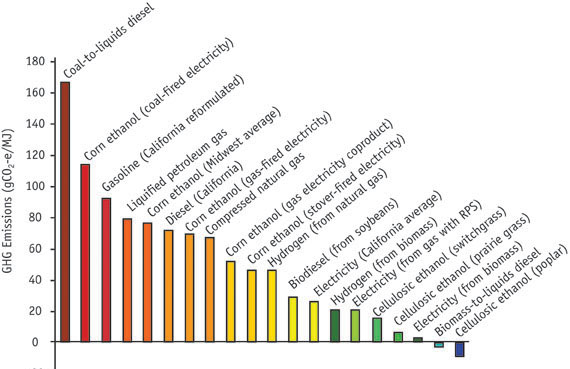
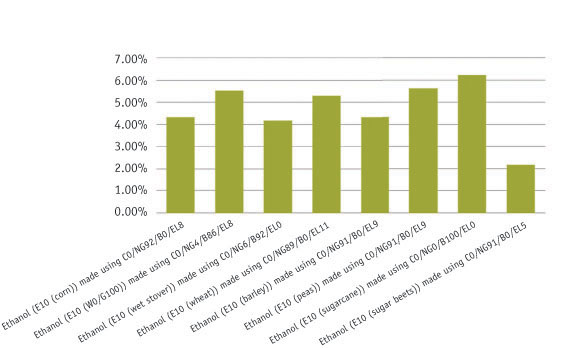
This discrepancy is also modelled in GHGenius, the model NRCan uses to calculate the potential emissions reductions from increases in ethanol and biodiesel production. Using data within the model, we can see the importance of the source of biofuel feedstock and the production techniques used in determining the emissions reductions. In Figure 10, a sample of these data are provided. They show, relative to crude-oil- sourced gasoline, that 10% ethanol fuel is likely to lead to overall emissions reductions, but not at the same rate for every technology or feedstock. In fact, some newer production technologies may lead to as much as a 90% emissions reduction relative to fossil fuel sources (see Growing Power Hairy Hill, http://www.Growingpower.com, for example), while corn-based ethanol that uses coal-fired electricity to run the process is very likely to lead to higher overall emissions than gasoline. As such, the exact emissions reductions attributable to the regulation will only be known once the sources of all the ethanol and biodiesel consumed in Canada are known.
Figure 10: Predicted GHG Emissions Reductions using GHGenius Compared to Gasoline for 10% Ethanol Fuel
While the type of ethanol and biodiesel is important, where it is produced and the effect the ethanol production has on domestic refined-products industries will likely be more important. This is because Canada's emission inventory will only reflect the emissions from production and consumption of refined products that takes place in Canada. Even though most biofuel production has lower GHG emissions than comparable fossil-fuel-based production, the emissions from the process are still greater than zero. This implies that if ethanol and biodiesel productions increase, but production from fossil fuels remains constant, emissions on the production side will actually go up, not down. This is certainly a possible outcome since the market for refined products is reasonably integrated on a North American basis, and Canada currently exports over 300,000 barrels per day of gasoline. Increasing ethanol production in Canada combined with increased exports of fossil-fuel-derived gasoline would negate any positive effects on the emissions inventory and would likely imply an increase in emissions relative to business as usual.
The import-export market effect could also turn in the opposite direction. Given the ethanol and biodiesel requirement, it is possible that much of the incremental supply could be sourced through imports. Any U.S. or Brazilian ethanol production emissions would not be reflected in Canada's emissions inventory since they do not occur within Canada. Imported biofuels can therefore decrease Canada's emissions if these imports reduce Canadian refined products production levels below business as usual.
Recent changes to the import-export market may have significant implications for the overall impact of the Canadian biofuel standard. Some U.S. states including California have introduced low carbon fuel standards, and the California standard in particular contains an adverse treatment of first generation ethanol in the U.S.— the so-called "corn coal" ethanol. As regulations in the U.S. disadvantage some ethanol producers, regulations in Canada are creating a demand for ethanol in general; as a result it is very possible some of this U.S. produced "corn coal" ethanol will be exported to Canada. Importantly, the emissions inventories would not be adversely affected in Canada since all of the electricity for production and any induced land-use changes would be taking place in the U.S.
Conclusions
As in previous Plans, the key question with respect to the biofuels standard is the emissions reduction factor applied to the incremental volume of ethanol and biodiesel consumption in Canada. The figures used by NRCan may be either high or low depending on the eventual impact of the standard on biofuel production in Canada and the activity in the refined products sector in Canada. If the biofuel standard serves to increase production of biofuels in Canada but does not decrease conventional gasoline or diesel production at the same time (relative to business as usual), then the policy cannot be said to be decreasing emissions. Conversely, if the policy leads to increased imports of even the most emissions-intensive U.S. biofuels, this may have a more positive impact on Canada's emissions inventories (since production takes place elsewhere) as long as there is a corresponding decrease in the refining of conventional feedstock gasoline and diesel. As such, it is not possible to reach a conclusion on the Plan's estimate with respect to the impact of the renewable fuel content standard.
<< Previous page | TOC | Next page >>
______________________________
38 Indirect land use changes capture the potential that total agricultural land will increase in order to meet demand for biofuel feedstocks. Contrast with direct land use changes that centre on crop-switching to biofuel feedstocks from other agricultural production.
39 See Farrell et al. (2006), Liska et al. (2009), Hill et al. (2006), and Searchinger et al. (2008) for details on life-cycle emissions from biofuels and fossil fuels.
40 Kammen Laboratory at Berkeley, 2008. http://www.ametsoc.org/atmospolicy/documents/2008ESSS/ESSS42508/Kammen-AMS-biofuels-4-25-08.pdf
41 Generated using the GHGenius model.