7.0 Conclusions and Recommendations
The NRTEE’s analysis and consideration of the
2009 Plan in the context of the KPIA leads it to
several conclusions.
First, it is likely that many of the emission reductions attributed to specific measures and policies are overestimated due to the particular methodological issues and approaches set out above. This is most apparent in the Technology Fund as it is a key component of the proposed Regulatory Framework, the accounting of the Climate Change Trust Fund, and the persistence of
free-ridership, rebound, and additionality issues in some of the individual measures. As the NRTEE was not in
a position to conduct alternative economic modelling,
we cannot be definitive in determining by how much emission reductions are overestimated. The publication of emission inventories for 2008 this year, for 2009 next year, and so forth, will bring additional clarity as to which measures are or are not achieving their stated emission reductions and assist in future forecasting
under KPIA plans and other government initiatives.
Second, there are deficiencies in relying exclusively on the KPIA annual assessment approach — with its short-term focus and unclear definition of emissions — as the formal accountability mechanism and process for forecasting and tracking emission reductions in Canada. Climate change is a long-term problem requiring long-term solutions, a point made by the NRTEE in its two previous responses. Transparent forecasting and evaluation processes are important for ensuring Canada is on a path to achieving its long-term reductions. Comparing forecasts of the impacts of the policies to the emissions reductions that eventually result from these policies can allow for improvement of both forecasting methods and of policy over time. Figure 6, developed by the NRTEE, illustrates below how we can incorporate analysis from the 2008–2012 Kyoto period into an appreciation of longer-term trends in meeting stated 2020, and later 2050, targets and follows upon a recommendation we made last year.
Third, a longer-term (post-2012) and transparent process of forecasting and accounting for GHG emission reductions could address not only these last two issues but other areas of question with the Plan. Projections of future emissions reductions attributed to policies estimate the effectiveness of different policy options. All forecasts, however, are inherently uncertain. Actual emissions reductions, determined retrospectively, can provide evidence both to the accuracy of forecasts and to the effectiveness of implemented policies. Properly constructed, this process could result in regular guidance to government not only for improving forecasting methodologies, but also for improving policy design and ultimately emission reductions outcomes. Methodologically sound forecasts can assist governments in judging the cost-effectiveness of spending significant public funds on various regulatory or voluntary programs that may deliver only modest emission reductions. In both instances, it can help guide decision makers in considering other choices or reinforcing measures to achieve emission reduction targets we have set for ourselves and help educate in the challenges behind emissions forecasting and constructing alternative scenarios. Environment Canada’s 2008 publication Detailed Emissions and Economic Modelling [26] is an excellent platform to build upon.
Currently, no public process for evaluating forecasts over the long term exists in Canada.
Figure 6: Comparison of GHG Emissions Pathways Under Various Scenarios
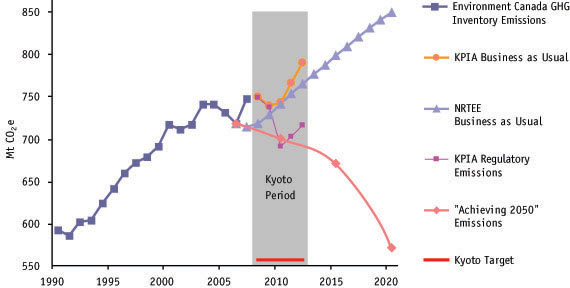
In this vein, and as part of the NRTEE’s broader consideration of the issues contemplated under the KPIA, we offer the recommendations below. These recommendations are guided by the main considerations established in Section 2 and build on the qualitative analysis in this Response. They help address issues associated with the accounting of projected reductions from the Regulatory Framework and propose an approach to ensure consistency with forthcoming GHG emissions inventory data for 2008 that can provide useful evaluation not just within the KPIA period but also over the longer term.
Recommendation 1: To ensure emission reductions can be accurately attributed to specific measures within a defined time period and to facilitate comparison of emission forecasts with actual emissions, the NRTEE recommends that for future KPIA Plans, the government forecasts estimates of future emissions reductions in terms of projected changes in Environment Canada’s GHG Emissions Inventory.
Recommendation 2: To continue the process to date of improving emission forecasting methodologies, measuring progress, and conducting effective policy evaluation, the NRTEE recommends that future KPIA Plans reflect both emissions forecasts and actual emissions data documented in the Environment Canada GHG Inventory and, further, that consideration be given to developing and implementing an ongoing public presentation of this information beyond the KPIA period either by government or an independent authority.
Recommendation 3: To ensure consistency in the approach to forecasting, to address issues of free-ridership, rebound, and additionality, and to ensure greater transparency between forecasted emission reductions on an individual measure-by-measure basis and those derived from integrated modelling, the NRTEE recommends that future KPIA Plans apply more consistent methodologies between the two and provide a more detailed and transparent explanation of differences between the integrated modelling forecasts and the program-by-program forecasts.
Recommendation 4: To build on the greater transparency provided in this year’s Plan with the alternative scenario and “high” and “low” forecasts for some individual measures, the NRTEE recommends that this presentation be deepened by providing additional information on the assumptions behind the various forecasts so they can be properly evaluated, and that each be more consistently presented in the Plan to facilitate comparison.
<< Previous page | TOC | Next page >>
_________________________