4.0 The 2009 Plan
The 2009 KPIA Plan is similar in many ways to the 2008 Plan. It presents projected emission reductions from individual policies or programs, as developed by the department responsible for the measure. It also presents an overall projection from the full suite of measures; this projection is developed by Environment Canada using an integrated modelling framework.[9]
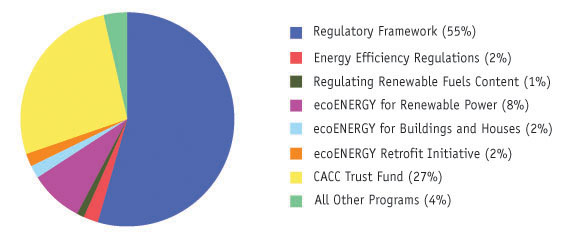
Figure 1 shows the percentage of emissions reductions attributed to individual measures over the Kyoto time frame from the 2009 Plan. The majority of the program-level emissions reductions are attributed to the Regulatory Framework for Industrial GHG Emissions, the Clean Air and Climate Change Trust Fund, the new Energy Efficiency Regulations, Renewable Fuel Content Standards, and the ecoENERGY for Renewable Power program.
Figure 1: Contributions of Programs and Policies to Cumulative Projected Canadian GHG Emissions Reductions, 2008-2012
| Emissions Reductions (Mt CO2e) | |||||||
|---|---|---|---|---|---|---|---|
| 2008 | 2009 | 2010 | 2011 | 2012 | Total | Annual Average | |
| Regulatory Framework | 0.0 | 0.9 | 46.6 | 55.3 | 61.6 | 164.4 | 32.9 |
| Energy Efficiency Regulations | 0.1 | 0.3 | 0.8 | 1.4 | 3.6 | 6.1 | 1.2 |
| Regulating Renewable Fuels Content | 0.0 | 0.0 | 0.3 | 1.0 | 2.1 | 3.4 | 0.7 |
| ecoENERGY for Renewable Power | 2.2 | 3.7 | 5.5 | 6.7 | 6.7 | 24.7 | 4.9 |
| ecoENERGY for Buildings and Houses | 0.3 | 0.6 | 1.1 | 1.6 | 2.0 | 5.6 | 1.1 |
| ecoENERGY Retrofit Initiative | 0.5 | 0.7 | 1.2 | 1.7 | 1.7 | 5.7 | 1.1 |
| CACC Trust Fund | 16.0 | 16.0 | 16.0 | 16.0 | 16.0 | 80.0 | 16.0 |
| All Other Programs | 0.6 | 1.9 | 2.5 | 2.8 | 3.0 | 10.8 | 2.2 |
| TOTAL | 19.6 | 24.1 | 73.9 | 86.4 | 96.6 | 300.6 | 60.1 |
This figure clearly illustrates the importance of the Regulatory Framework in contributing to emission reductions as laid out in the Plan, representing 55% of all forecast reductions. While the remaining programs provide a relatively smaller share of total reductions, the KPIA obligates government to set them out individually and provide an estimated emission reduction for each one. Accounting for emissions reductions may vary across programs, but the overall impact of these programs on the total set of emission reductions is modest. This measure-by-measure breakdown in the 2009 Plan has changed little from the 2008 Plan in terms of numbers, assumptions, and methodologies.
However, there are some differences in the 2009 Plan, in the details of the Plan, and the context in which the Plan has been developed. Some of these changes are in response to suggestions from the NRTEE in previous KPIA Responses but also come from the Spring 2009 Audit of the 2007 and 2008 KPIA Plans by the Commissioner of the Environment and Sustainable Development (CESD).
For each measure-level forecast, the Plan now includes a range of emission reductions that could result from the measure. This uncertainty analysis is a response to a recommendation from the CESD. The Spring 2009 CESD report suggested the government should "describe the quantitative or qualitative uncertainties related to the expected GHG reductions of each measures. A range of potential emission reduction levels should be presented for the annual plans as a whole and for the individual measures where possible."[10]
Similarly, uncertainty analysis was developed for the integrated modelling. Two distinct scenarios using the integrated modelling framework are presented to illustrate how different assumptions about economic growth and the price of oil can affect growth of emissions. In principle, analysis of the uncertainty that underlies the estimates provided for individual programs clearly improves the overall forecasting practice. Providing alternate scenarios based on different assumptions reinforces the fact that actual emission reductions are subject to factors beyond government control, such as the state of the global economy. The NRTEE considers both of these useful additions to the KPIA Plan and offers recommendations on how to further improve the uncertainty analysis later in this document.
<< Previous page | TOC | Next page >>
_________________________________
9 In the 2008 Plan, the Government introduced its integrated modelling framework for the purposes of the KPIA. The modelling is undertaken using Environment Canada's Energy-Economy-Environment Model for Canada, or E3MC. Under this approach, all policies are modelled together in the E3MC model, which simulates the supply, price, and demand for all fuels and also includes macroeconomic effects. Free-ridership, additionality, and interaction effects are addressed through integrated modelling.